WW.IMOSHL.2022.G5 en
Let \(ABC\) be a triangle and \(\ell_1,\ell_2\) be two parallel lines. Let \(\ell_i\) intersects line \(BC,CA,AB\) at \(X_i,Y_i,Z_i\), respectively. Let \(\Delta_i\) be the triangle formed by the line passed through \(X_i\) and perpendicular to \(BC\), the line passed through \(Y_i\) and perpendicular to \(CA\), and the line passed through \(Z_i\) and perpendicular to \(AB\). Prove that the circumcircles of \(\Delta_1\) and \(\Delta_2\) are tangent.
Solution-1
Throughout the solutions, \(\sphericalangle(p, q)\) will denote the directed angle between lines \(p\) and \(q\), taken modulo \(180^{\circ}\).
Let the vertices of \(\Delta_{i}\) be \(D_{i}, E_{i}, F_{i}\), such that lines \(E_{i} F_{i}, F_{i} D_{i}\) and \(D_{i} E_{i}\) are the perpendiculars through \(X, Y\) and \(Z\), respectively, and denote the circumcircle of \(\Delta_{i}\) by \(\omega_{i}\).
In triangles \(D_{1} Y_{1} Z_{1}\) and \(D_{2} Y_{2} Z_{2}\) we have \(Y_{1} Z_{1} \| Y_{2} Z_{2}\) because they are parts of \(\ell_{1}\) and \(\ell_{2}\). Moreover, \(D_{1} Y_{1} \| D_{2} Y_{2}\) are perpendicular to \(A C\) and \(D_{1} Z_{1} \| D_{2} Z_{2}\) are perpendicular to \(A B\), so the two triangles are homothetic and their homothetic centre is \(Y_{1} Y_{2} \cap Z_{1} Z_{2}=A\). Hence, line \(D_{1} D_{2}\) passes through \(A\). Analogously, line \(E_{1} E_{2}\) passes through \(B\) and \(F_{1} F_{2}\) passes through \(C\).
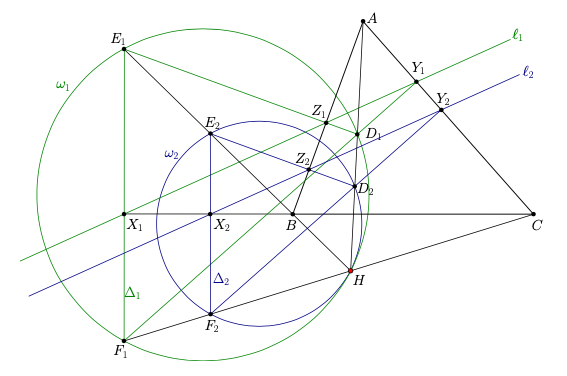
The corresponding sides of \(\Delta_{1}\) and \(\Delta_{2}\) are parallel, because they are perpendicular to the respective sides of triangle \(ABC\). Hence, \(\Delta_{1}\) and \(\Delta_{2}\) are either homothetic, or they can be translated to each other. Using that \(B, X_{2}, Z_{2}\) and \(E_{2}\) are concyclic, \(C, X_{2}, Y_{2}\) and \(F_{2}\) are concyclic, \(Z_{2}E_{2} \perp AB\) and \(Y_{2}, F_{2} \perp A C\) we can calculate
\[\begin{align*} \sphericalangle\left(E_{1} E_{2}, F_{1} F_{2}\right) & =\sphericalangle\left(E_{1} E_{2}, X_{1} X_{2}\right)+\sphericalangle\left(X_{1} X_{2}, F_{1} F_{2}\right)=\sphericalangle\left(B E_{2}, B X_{2}\right)+\sphericalangle\left(C X_{2}, C F_{2}\right) \\ & =\sphericalangle\left(Z_{2} E_{2}, Z_{2} X_{2}\right)+\sphericalangle\left(Y_{2} X_{2}, Y_{2} F_{2}\right)=\sphericalangle\left(Z_{2} E_{2}, \ell_{2}\right)+\sphericalangle\left(\ell_{2}, Y_{2} F_{2}\right) \\ & =\sphericalangle\left(Z_{2} E_{2}, Y_{2} F_{2}\right)=\sphericalangle(A B, A C) \not \equiv 0, \tag{1} \end{align*}\]
and conclude that lines \(E_{1} E_{2}\) and \(F_{1} F_{2}\) are not parallel. Hence, \(\Delta_{1}\) and \(\Delta_{2}\) are homothetic; the lines \(D_{1}D_{2}, E_{1}E_{2}\), and \(F_{1}F_{2}\) are concurrent at the homothetic centre of the two triangles. Denote this homothetic centre by \(H\). For \(i=1,2\), using (1), and that \(A, Y_{i}, Z_{i}\) and \(D_{i}\) are concyclic,\[\begin{aligned} \sphericalangle\left(H E_{i}, H F_{i}\right) & =\sphericalangle\left(E_{1} E_{2}, F_{1} F_{2}\right)=\sphericalangle(A B, A C) \\ & =\sphericalangle\left(A Z_{i}, A Y_{i}\right)=\sphericalangle\left(D_{i} Z_{i}, D_{i} Y_{i}\right)=\sphericalangle\left(D_{i} E_{i}, D_{i} F_{i}\right) \end{aligned}\]
so \(H\) lies on circle \(\omega_{i}\). The same homothety that maps \(\Delta_{1}\) to \(\Delta_{2}\), sends \(\omega_{1}\) to \(\omega_{2}\) as well. Point \(H\), that is the centre of the homothety, is a common point of the two circles, That finishes proving that \(\omega_{1}\) and \(\omega_{2}\) are tangent to each other.