WW.IMOSHL.2022.G3 en
Let \(ABCD\) be a cyclic quadrilateral. Assume that the points \(Q, A, B, P\) are collinear in this order, in such a way that the line \(AC\) is tangent to the circle \(ADQ\), and the line \(BD\) is tangent to the circle \(BCP\). Let \(M\) and \(N\) be the midpoints of segments \(BC\) and \(AD\), respectively. Prove that the following three lines are concurrent: line \(CD\), the tangent of circle \(ANQ\) at point \(A\), and the tangent to circle \(BMP\) at point \(B\).
Solution-1
We first prove that triangles \(A D Q\) and \(C D B\) are similar. Since \(A B C D\) is cyclic, we have \(\angle D A Q=\angle D C B\). By the tangency of \(A C\) to the circle \(A Q D\) we also have \(\angle C B D=\angle C A D=\angle A Q D\). The claimed similarity is proven.
Let \(R\) be the midpoint of \(C D\). Points \(N\) and \(R\) correspond in the proven similarity, and so \(\angle Q N A=\angle B R C\).
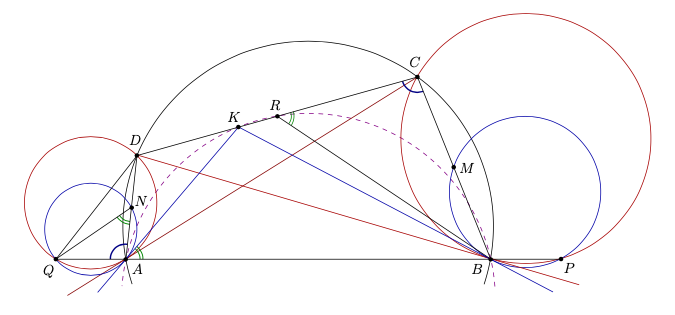
Let \(K\) be the second common point of line \(C D\) with circle \(A B R\) (i.e., if \(C D\) intersects circle \(A B R\), then \(K \neq R\) is the other intersection; otherwise, if \(C D\) is tangent to \(C D\), then \(K=R\) ). In both cases, we have \(\angle B A K=\angle B R C=\angle Q N A\); that indicates that \(AK\) is tangent to circle \(A N Q\). It can be showed analogously that \(BK\) is tangent to circle \(BMP\).
Comment. Note that \(M\) and \(N\) can be any points on lines \(BC\) and \(AD\) such that \(BM:MC = DN:NA\), as we then simply choose \(R\) to be such that \(DR:RC\) is that same ratio, and the rest of the proof remains unchanged.