WW.IMOSHL.2022.G2 en
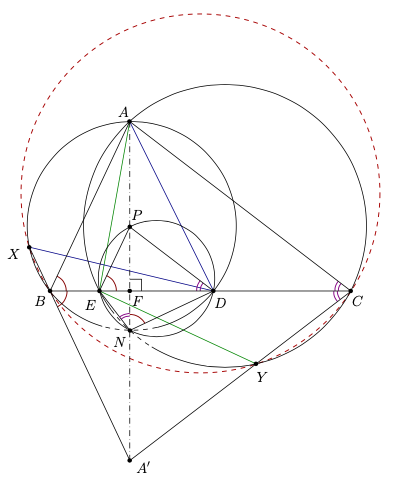
In the acute-angled triangle \(ABC\), the point \(F\) is the foot of the altitude from \(A\), and \(P\) is a point on the segment \(AF\). The lines through \(P\) parallel to \(AC\) and \(AB\) meet \(BC\) at \(D\) and \(E\), respectively. Points \(X \ne A\) and \(Y \ne A\) lie on the circles \(ABD\) and \(ACE\), respectively, such that \(DA = DX\) and \(EA = EY\).
Prove that \(B, C, X,\) and \(Y\) are concyclic.
Solution-1
Let \(A^{\prime}\) be the intersection of lines \(B X\) and \(C Y\). By power of a point, it suffices to prove that \(A^{\prime} B \cdot A^{\prime} X=A^{\prime} C \cdot A^{\prime} Y\), or, equivalently, that \(A^{\prime}\) lies on the radical axis of the circles \(A B D X\) and \(ACEY\).
From \(D A=D X\) it follows that in circle \(A B D X\), point \(D\) bisects of one of the \(\operatorname{arcs} A X\). Therefore, depending on the order of points, the line \(B C\) is either the internal or external bisector of \(\angle ABX\). In both cases, line \(B X\) is the reflection of \(BA\) in line \(BDC\). Analogously, line \(C Y\) is the reflection of \(CA\) in line \(BC\); we can see that \(A^{\prime}\) is the reflection of \(A\) in line \(B C\), so \(A,F\) and \(A^{\prime}\) are collinear.
By \(PD \| AC\) and \(PE \| AB\) we have \(\frac{FD}{FC} = \frac{FP}{FA} = \frac{FE}{FB}\), hence \(FD \cdot FB = FE \cdot FC\). So, point \(F\) has equal powers with respect to circles \(ABDX\) and \(ACEY\).
Point \(A\), being a common point of the two circles, is another point with equal powers, so the radical axis of circles \(ABDX\) and \(ACEY\) is the altitude \(A F\) that passes through \(A^{\prime}\).