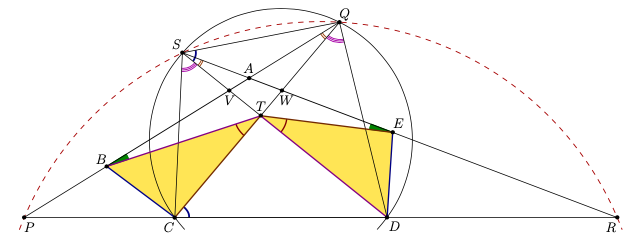
WW.IMOSHL.2022.G1 en
Let \(ABCDE\) be a convex pentagon such that \(BC=DE\). Assume that there is a point \(T\) inside \(ABCDE\) with \(TB=TD,TC=TE\) and \(\angle ABT = \angle TEA\). Let line \(AB\) intersect lines \(CD\) and \(CT\) at points \(P\) and \(Q\), respectively. Assume that the points \(P,B,A,Q\) occur on their line in that order. Let line \(AE\) intersect \(CD\) and \(DT\) at points \(R\) and \(S\), respectively. Assume that the points \(R,E,A,S\) occur on their line in that order. Prove that the points \(P,S,Q,R\) lie on a circle.
Solution-1
By the conditions we have \(B C=D E, C T=E T\) and \(T B=T D\), so the triangles \(T B C\) and \(T D E\) are congruent, in particular \(\angle B T C=\angle D T E\).
In triangles \(T B Q\) and \(T E S\) we have \(\angle T B Q=\angle S E T\) and \(\angle Q T B=180^{\circ}-\angle B T C=180^{\circ}-\) \(\angle D T E=\angle E T S\), so these triangles are similar to each other. It follows that \(\angle T S E=\angle B Q T\) and
\[\frac{T D}{T Q}=\frac{T B}{T Q}=\frac{T E}{T S}=\frac{T C}{T S}\]
By rearranging this relation we get \(T D \cdot T S=T C \cdot T Q\), so \(C, D, Q\) and \(S\) are concyclic. (Alternatively, we can get \(\angle C Q D=\angle C S D\) from the similar triangles \(T C S\) and \(T D Q\).) Hence, \(\angle D C Q=\angle D S Q\). Finally, from the angles of triangle \(C Q P\) we get\[\angle R P Q=\angle R C Q-\angle P Q C=\angle D S Q-\angle D S R=\angle R S Q\]
which proves that \(P, Q, R\) and \(S\) are concyclic.