LV.NOL.2023.10.5 en lv
Volejbola turnīrā katra komanda spēlēja ar katru tieši vienu reizi; neizšķirtu nav. Ir zināms: lai kuru komandu mēs izvēlētos (apzīmēsim to ar \(K\)), tā ir izcīnījusi tieši tikpat uzvaru, cik kopā izcīnījušas visas tās komandas, pret kurām \(K\) uzvarēja. Kāds var būt komandu skaits, kas piedalījās šajā turnīrā? (Nevienā turnīrā nav mazāk kā \(2\) komandas.)
Atrisinājums
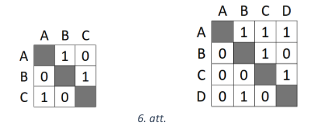
Turnīrā varēja piedalīties \(3\) vai \(4\) komandas, piemēram, atbilstošu spēļu norisi skat. 6.att., kur skaitlis \(1\) norāda rindā rakstītās komandas atbilstošās uzvaras pret komandām, kas rakstītas kolonnā, skaitlis \(0\) norāda zaudējumu (piemēram, trīs komandu gadījumā komanda \(A\) ir uzvarējusi komandu \(B\) un zaudējusi komandai \(C\)). Pamatosim, ka cits komandu skaits nav iespējams. Komandu skaits nevar būt \(2\), jo tad ir tikai viena spēle, kurā ir uzvarētājs un zaudētājs.
Ievērosim, ka \(x\) komandas savā starpā kopā izspēlē \((x-1)+(x-2)+\cdots+2+1=\frac{x(x-1)}{2}\) spēles un izcīna tikpat uzvaras. Tā kā vidēji uz vienu komandu ir \(\frac{x-1}{2}\) uzvaras, tad ir komanda ar vismaz \(\frac{x-1}{2}\) uzvarām (ja šādas komandas nebūtu, tad kopējais uzvaru skaits būtu mazāks nekā \(\frac{x(x-1)}{2}\)).
Apzīmēsim turnīra komandu skaitu ar \(x\) un pieņemsim, ka lielākais uzvaru skaits vienai komandai ir \(y\); apzīmēsim šo komandu ar \(A\). Tās \(y\) komandas, kas zaudējušas pret \(A\), savā starpā spēlējušas \(\frac{y(y-1)}{2}\) spēles, kurās izcīnītas \(\frac{y(y-1)}{2}\) uzvaras; bez tam viņām varbūt ir vēl kādas citas uzvaras. Tāpēc \(y \geq \frac{y(y-1)}{2}\), no kurienes izriet, ka \(y \leq 3\).
Apskatām visas iespējamās \(y\) vērtības.
- Ja \(y=3\), tad A izcīnījusi \(3\) uzvaras pret \(B\), \(C\), \(D\). Tātad \(C\) un \(D\) savā starpā arī ir \(3\) uzvaras. Ja būtu vēl kāda komanda \(E\), tad tā ir uzvarējusi gan pret \(A\), gan pret \(B\), \(C\), \(D\) (citādi \(B\), \(C\), \(D\) kopā būtu vairāk par \(3\) uzvarām), un tā ir pretruna ar to, ka \(A\) ir vislielākais uzvaru skaits. Tātad šajā gadījumā citu komandu nav, un turnīrā piedalās \(4\) komandas.
- Ja \(y=2\), tad no iepriekš iegūtās nevienādības \(y \geq \frac{x-1}{2}\) izriet, ka \(x \leq 5\). Mums tikai jānoskaidro, vai var būt, ka \(x=5\). Ja \(x=5\), tad tiek izspēlētas \(10\) spēles un izcīnītas \(10\) uzvaras. Ja lielākais uzvaru skaits ir \(2\), tad visām komandām ir pa \(2\) uzvarām, un tā ir pretruna ar uzdevuma nosacījumiem. Tāpēc \(x \neq 5\).
- Ja \(y=1\), tad no \(y \geq \frac{x-1}{2}\) izriet, ka \(x \leq 3\). Tātad citu iespēju bez sākumā uzrādītajām nav.