LV.AMO.2017.10.3 lv
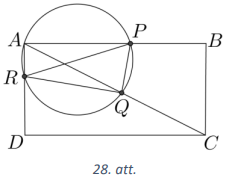
Taisnstūrī \(ABCD\) caur virsotni \(A\) novilkta riņķa līnija, kas nogriežņus \(AB,\ AC\) un \(AD\) krusto attiecīgi punktos \(P,\ Q\) un \(R\). Pierādīt, ka \(AB \cdot AP+AD \cdot AR=AC \cdot AQ\) !
Atrisinājums-2
Apzīmējam \(\sphericalangle BAC=\alpha\), tad \(\sphericalangle CAD=90^{\circ}-\alpha\) (skat. 28.att.). Izmantojot kosinusu teorēmu trijstūrī \(APQ\) un \(ARQ\), iegūstam
\[\begin{gather*} PQ^{2}=AP^{2}+AQ^{2}-2 \cdot AP \cdot AQ \cdot \cos \alpha \tag{1}\\ RQ^{2}=AR^{2}+AQ^{2}-2 \cdot AR \cdot AQ \cdot \cos \left(90^{\circ}-\alpha\right) \tag{2} \end{gather*}\]
Tā kā \(\sphericalangle PAR=90^{\circ}\), tad \(PR\) ir riņķa līnijas diametrs un \(\sphericalangle PQR=90^{\circ}\) kā ievilktais leņķis, kas balstās uz diametra \(PR\). Izmantojot Pitagora teorēmu trijstūrī \(PAR\) un \(PQR\), iegūstam \(AP^{2}+AR^{2}=PQ^{2}+RQ^{2}\), jo \(PR\) ir kopīga mala abiem trijstūriem. Iegūtajā vienādībā ievietojam \((1)\) un \((2)\)\[AP^{2}+AR^{2}=AP^{2}+AQ^{2}-2 \cdot AP \cdot AQ \cdot \cos \alpha+AR^{2}+AQ^{2}-2 \cdot AR \cdot AQ \cdot \cos \left(90^{\circ}-\alpha\right)\]
Vienkāršojot iegūstam\[2AQ^{2}-2 \cdot AP \cdot AQ \cdot \cos \alpha-2 \cdot AR \cdot AQ \cdot \cos \left(90^{\circ}-\alpha\right)=0\]
Dalot abas vienādības puses ar \(AQ \neq 0\), iegūstam\[AQ=AP \cdot \cos \alpha+AR \cdot \cos \left(90^{\circ}-\alpha\right)\]
Reizinot abas vienādības puses ar \(AC \neq 0\), iegūstam\[\begin{equation*} AQ \cdot AC=AP \cdot AC \cdot \cos \alpha+AR \cdot AC \cdot \cos \left(90^{\circ}-\alpha\right) \tag{3} \end{equation*}\]
No trijstūra \(ABC\) iegūstam, ka \(\cos \alpha=\frac{AB}{AC}\) jeb \(AB=AC \cdot \cos \alpha\), un no trijstūra \(ADC\) izriet, ka \(\cos \left(90^{\circ}-\alpha\right)=\frac{AD}{AC}\) jeb \(AD=AC \cdot \cos \left(90^{\circ}-\alpha\right)\). Ievietojot iegūtās sakarības vienādībā \((3)\), iegūstam vajadzīgo \(AQ \cdot AC=AP \cdot AB+AR \cdot AD\).